基准导航:
Home News Latest news SQA Advanced Qualifications’ Heritage: 100 Years of Higher National qualifications from Scotland to the World
SQA Advanced Qualifications’ Heritage 2 December 2025

100 Years of Higher National qualifications from Scotland to the World
In 1925, 24 awards were made available under Scotland's new National Certificate scheme, laying the foundation for something far more enduring than anyone could have predicted.
In 2025, Higher National qualifications – Certificates and Diplomas (HNCs and HNDs) are marking their centenary. Over the last 100 years, these qualifications have changed names, formats, and mediums, but their core purpose has remained the same: to equip learners with the knowledge and skills needed to thrive in the workplace, helping employers meet industry needs, and together, contributing to Scotland's economy and society.
As we celebrate the centenary of Higher National qualifications, we look back at how far things have come and look forward to what's next.
Qualifications to address skill shortages
The earliest HN qualifications, or National Certificates as they were then known, came after an urgent investigation by a post-war committee into the industrial training and technical education of young people in industry. This led to the introduction of National Certificates in Mechanical Engineering and Chemistry in 1925, new technical qualifications designed to address a shortage in engineering expertise.
Qualifications were predominantly earned by those attending a few night classes a week after a day of working a full-time job. Despite initial scepticism from some employers, the credibility of these awards steadily grew, especially as professional bodies began to recognise their value. Other subjects were gradually introduced, with the Electrical Engineering HNC and Plumbing appearing for the first time in 1930, and Mining Surveying in the 1950s.
The evolution of Television Production
Fast forward to 2025, and the diversity of HNC and HND subjects offered is huge. From Accounting and Forestry to Social Care and Civil Engineering, today's qualifications are designed in collaboration with colleges, universities and industry to reflect industry demands.
Take Television Production which has evolved dramatically since the 1980's. Back then, learners were taught how to operate heavy cameras, edit tape-to-tape, and physically distribute content by post. Today's learners master digital techniques, create content for online streaming platforms, and develop skills that combine creativity, storytelling, and technical expertise. Equipment once reserved for studios is now accessible on smartphones, yet professional training remains vital. HN qualifications are not only for learning about equipment and technology, but also about the craft of making content for screen, and the roles and professional practices required to do this. Understanding sustainability and how to calculate the carbon footprint of a production is also now essential for programmes to be commissioned, and in turn, is required knowledge for freelancers and employees.
From darkrooms to digital
When the first Photography courses launched in the 1970s, the medium still relied heavily on film. Students had to master the darkroom – a complicated combination of chemicals, enlargers, and timed exposures. Crafting a final image meant physically processing negatives, carefully adjusting exposure under red light, and using specialist techniques to perfect each print.
Today, the darkroom is more likely to be a computer screen than a tray of developer fluid. Modern HNC and HND Photography students are trained on DSLRs, mirrorless cameras, and editing software like Adobe Lightroom and Photoshop. While some courses still maintain darkroom modules, the syllabus has evolved to include digital image editing and studio lighting.
The transformation hasn't stopped at technology. The rise of freelancing and content creation has changed how photographers build careers. Where once photography graduates might have aimed for positions in newspapers or studios, today's learners are more likely to start their own business or work as self-employed creatives. In response, Higher National qualifications now include business modules, covering everything from branding and marketing to tax returns and contracts.
Gail English, Qualifications Manager at SQA commented: 'Everybody has a camera in their pocket now. HN learners are now developing skills in how to make those images and videos stand out—how to understand light, composition, sound, and storytelling, and then use that to build a career.'
Computing through the years
When Computing courses were first introduced, they focused on theory – algorithms, binary logic, maths – and learners were introduced to early programming languages with limited real-world application. The qualifications were largely delivered in evening classes or part-time formats, aimed at engineers and professionals upskilling in an emerging field.
Even into the 1980s and early 1990s, computers were perceived as very technical machines. Qualifications followed suit, often focusing on systems analysis and programming languages. As personal computing entered the mainstream in the 1990s, HNCs and HNDs began to broaden their scope, with web development and multimedia beginning to take centre stage, responding to changes in the job market and society at large.
By the early 2000s, there was a major shift toward coding, web development, and cybersecurity.
It's hard to picture the 1970s computing student anticipating that Higher Nationals would include qualifications in Esports and the competitive videogaming industry, but that's exactly what's happening. Currently under development, learners will soon be able to enrol in brand new HNCs and HNDs in Esports. These courses won't just focus on gameplay; they cover event management, marketing, broadcasting, and even team dynamics. It's a reflection of how HNs continue to adapt – combining practical skills with academic knowledge to stay ahead of industry trends.
As Bobby Elliot, SQA Qualifications Manager and former Computing lecturer at Clydebank College, puts it: 'If you'd told me back in the 90s that we'd be using AI to help design qualifications in video games, I'd never have believed you. But that's what's brilliant about HNs – they've always changed with the times.'
SQA Advanced Qualifications: A global perspective
Whilst HNCs and HNDs have been transforming lives across Scotland for a century, SQA's commitment to vocational education extends beyond Scottish borders. SQA Advanced Qualifications bring the same rigorous, industry-focused approach to learners internationally. These qualifications mirror the structure and quality of Higher Nationals, offering internationally recognised credentials that combine academic knowledge with practical skills.
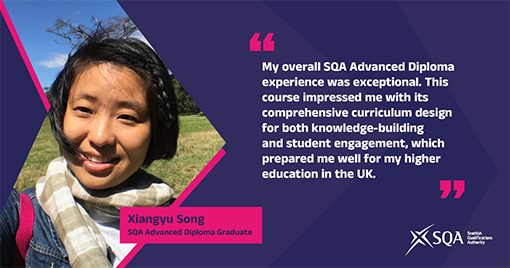
China is SQA's largest international market. Since 2003, SQA has partnered with the Chinese Service Centre for Scholarly Exchange (CSCSE) to deliver SQA Advanced Diplomas in numerous Chinese universities. To date, over 130,000 Chinese students have studied SQA Advanced Qualifications, with graduates progressing to universities worldwide or entering employment equipped with the skills employers value.
With solid professional knowledge, strong cross-cultural communication skills, and a comprehensive understanding of international issues, our graduates are excelling in their respective fields, driving social progress and international exchanges’, Ms Haixia Zhang, General Manager from Beijing Yinhong said. She added: 'The success of the SQA Advanced Diploma programme not only provides students with high-quality educational resources and development opportunities but also sets a model for UK educational professions and promotes cultural exchange between our two countries.'
Available in subjects ranging from Business and IT to Engineering and Hospitality, these qualifications provide clear pathways to career success and demonstrate how the principles established in Scotland a century ago – designed with employers, responsive to industry needs, and focused on real-world application – continue to support learners globally.